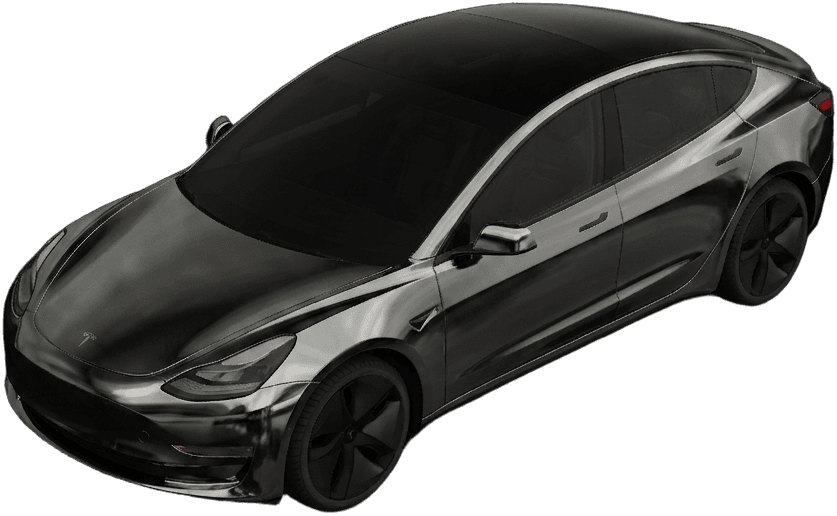
Short answer: a chrome delete blacks out a car's brightwork with vinyl rather than paint. It is the highest-impact change per dollar you can make to a car's appearance, and the main thing that varies between quotes is which pieces the shop counts as "the trim".
Walk around a car park and you can pick out the cars that have had it done, even if you cannot say why. Removing the bright window surrounds and mirror caps pulls the whole greenhouse of the car into one dark mass. It is the change that makes an older car look like the current model year.
Which pieces are actually involved
This is where quotes diverge, so it is worth being specific. A chrome delete is not one part, it is a list.
Almost always included
- The window surround trim along the top of the doors
- The B-pillars, if they are not already gloss black from the factory
- Mirror caps
- Badges
Sometimes included, sometimes quoted separately
- Door handle inserts
- The trim strip below the doors, if the car has one
- Roof rails on an SUV or wagon
- Light surrounds and the trim around the charge port
Nearly always separate
- Lower rocker panels
- Anything on the bumpers
- Wheel finishes
Get the list in writing. A quote that says "chrome delete" and a quote that itemises nine pieces are not comparable, and the cheaper one is frequently cheaper because it covers less. Our breakdown of partial wrap packages lists the ranges we see for each of these, including the combined "stealth package" that bundles a chrome delete with a black roof and mirrors.
Vinyl, not paint
Trim is a bad candidate for paint. The pieces are small, fiddly, often plastic, and frequently removable, which means painting them well requires taking the car apart and then living with a permanent decision on a part that is genuinely hard to colour-match if it is ever damaged.
Vinyl solves all of that. It goes on over the existing trim, it comes off with heat, and if a mirror cap gets scuffed in a car park you re-wrap one mirror cap instead of repainting it. The only case for painting trim is when the chrome underneath is already pitted or peeling, because film follows the surface it sits on and will telegraph a rough one.
Gloss black or satin black
Gloss black is the default, and it is the default for a good reason: it matches the glass it sits next to, so the window line reads as one continuous dark band. That is the whole illusion. Satin black interrupts it slightly, because the glass is shiny and the trim is not.
Satin earns its place in two situations. On a matte or satin body wrap, gloss trim can look bolted-on, and matching the finish of the body reads better. And on older trim that is no longer perfectly smooth, satin's diffused surface hides minor imperfections that gloss would highlight. If you are weighing this up on a car you plan to wrap fully, our comparison of matte, gloss and satin covers how the two finishes age differently.
There is a third option people forget: body-colour delete. Wrapping the trim in the car's own colour rather than black makes the car read as a single moulded shape. It is subtler, it is harder to get right, and on a white or light grey car it is genuinely striking.
What a good install looks like
You can judge a chrome delete in about twenty seconds, and it is worth knowing what to look at before you hand over money.
Look at the ends. Every piece of trim has two ends, and both are where a rushed job shows. The film should be tucked and sealed, not trimmed flush and left. A flush-cut end lifts within a season.
Look at the corners. Window trim turns corners, usually tightly. A good installer heats and forms the film around that corner in one piece. A fast one makes a relief cut and hopes you do not look. You should not be able to find a seam at a corner.
Look along the length in reflected light. Stand at the front of the car and sight down the trim line. Bubbles, dust inclusions and stretch marks all show up in a raking reflection and are invisible head-on.
Check the badges. If badges were wrapped rather than removed and replaced, the film should follow the lettering rather than bridging over it. Bridged film catches light at the edges and looks like a sticker, because functionally it is one.
Does it damage the trim underneath
Not when it is done and undone properly. The film sits on trim, not on paint, and the adhesive used on automotive vinyl is designed to release with gentle heat.
The failure mode is neglect rather than installation. Cheap film left on for years in hard sun goes brittle, and brittle film does not release in sheets, it releases in fragments. That turns a twenty-minute removal into an afternoon, and an afternoon is when people get impatient and reach for a blade. Our guide on removing a wrap goes into what makes a removal expensive and how to avoid ending up there.
The practical rule: if you would not leave it on past its life, you will never have a removal problem.
Where it fits in a bigger plan
A chrome delete is the cheapest useful test of a shop. It costs a fraction of a full wrap, it takes a few hours rather than days, and it shows you exactly how that installer handles edges, corners and finishing. If the trim is immaculate three months later, you have found the shop to trust with the whole car. If it is lifting, you have learned that for a small fraction of the price.
It also pairs well with almost everything else. A chrome delete plus a gloss black roof is the classic combination, and it transforms a light-coloured car for well under full-wrap money. On the larger bodies it matters even more, because there is simply more trim to darken — the Model S and Model X pages show how the blacked-out window line changes the proportions of a long car.
And if you eventually go for a full colour change, the delete stays. It is not wasted spend, it is the first layer of the same plan.
See it on your car first
Trim is small, which makes it strangely hard to picture. The difference between chrome, gloss black and body-colour trim on your specific car is the kind of thing that seems obvious in the abstract and surprises you in a render.
Generate all three on a template of your exact model in the design studio and compare them side by side before you book anything, or get the iOS app and do it standing next to the car.