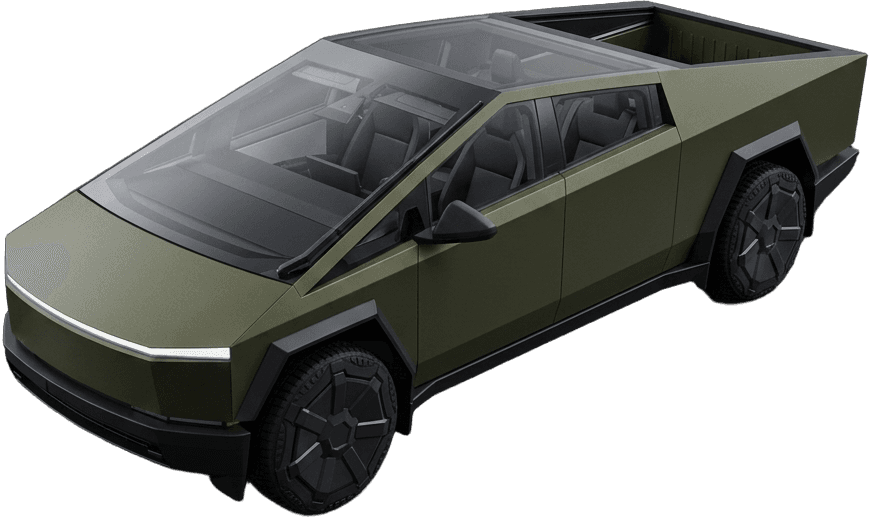
Short answer: yes, you can wrap stainless steel, and the film is the same. What changes is everything either side of the film — how the panel is prepared before it goes on, and how residue is handled when it comes off. There is no clear coat to forgive a shortcut in either direction.
Unpainted bodies used to be a curiosity. Since angular stainless trucks arrived in volume they have become a normal line on a wrap shop's calendar, and the shops that do a lot of them have developed a noticeably different process.
Here is what actually differs.
Preparation is most of the job
On a painted car, the surface a wrap bonds to is clear coat: smooth, sealed, chemically consistent, and designed from the factory to be washed. Preparation is a thorough clean and a solvent wipe.
Bare stainless is none of those things. It arrives with mill oils from rolling and forming, it has an oxide layer, and it holds fingerprints in a way clear coat does not. Vinyl adhesive bonds to whatever is on the surface, not to the metal, so anything left behind becomes the weak layer. A wrap that lifts at the edges three months later usually lifted because a panel was not stripped properly on day one.
A shop that does this often will spend a disproportionate share of the job on degreasing and final wipe-down, and will handle prepared panels with gloves from that point on. If you watch a stainless install and it looks like they are spending ages cleaning, that is the job going well.
The corollary matters for you too: do not touch the panels between prep and install. A single palm print on a cleaned panel is a defect.
Surface texture and what it does to the finish
Stainless body panels have a directional surface, and the film sits on top of it rather than hiding it. A gloss film over a textured panel can pick up a faint grain in raking light, which some people love and some people did not expect.
Matte and satin films are the more forgiving choice here, because their diffused surface does not pick up the reflection that reveals the texture underneath. It is one of several reasons tactical matte finishes became the default look on these trucks rather than a trend — they suit the material. If you are weighing finishes, our matte vs gloss vs satin comparison covers how each behaves over a season.
Panel geometry: the part that helps you
Here is the good news. Large flat panels are the easiest surfaces in vehicle wrapping. There is no compound curve to heat and stretch, no wheel arch to form film around, no complex nose to manage. An installer working on a flat slab is doing the simplest version of their job.
It also makes the design side easier. Flattening a curved body onto a template always distorts it, which is why artwork on a sculpted car has to stay away from the tight-curvature regions — our visualizer guide explains that in detail. Flat panels barely distort at all, so graphics land where you put them. Geometric designs, hard-edged liveries and large-scale patterns work on these bodies in a way they simply do not on a rounded sedan.
That is why the finishes on the Cybertruck wrap page skew graphic and high-contrast. The body rewards it.
Why the quote does not drop
People reasonably expect flat panels to be cheaper, and then the quote comes back at the top of the range.
The labour per panel really is simpler. But these are big vehicles with a lot of square feet, so the film cost is high, and the edges — where panels meet, around the lighting, along the bed — are where the hours go. Simple middles and fiddly edges is a different distribution of work, not less work.
Expect the range our cost guide lists for large bodies rather than a discount for simplicity.
Removal: agree the method before installation
This is the conversation to have up front, because it is the one genuine risk.
On a painted car, removal leaves adhesive residue on clear coat, which tolerates a solvent and a bit of mechanical persuasion. On bare stainless there is no sacrificial protective layer. Residue still comes off, but the method has to be gentler and slower, and the wrong approach — an aggressive solvent, an abrasive pad, a blade — can leave marks in the surface that are not correctable the way a polish corrects paint.
So ask, before anything is installed: what film are you using, and what is your removal process for this material? A shop with real experience will answer immediately and specifically. A shop that has not thought about it will tell you it comes off fine.
The other half of removal risk is time. Film that is still pliable comes off in sheets; film left years past its life goes brittle and comes off in fragments. That is true on any car, and it is the main thing that turns a manageable job into an expensive one — our guide on removing a wrap covers the economics of that.
Protection as the actual motive
A lot of stainless owners wrap for reasons that have nothing to do with colour.
An unpainted panel shows fingerprints around the handles, water spotting after rain, and the marks of everyday contact in a way that a clear-coated car does not. A wrap simply covers all of it, and swaps a maintenance problem for a maintenance routine. Plenty of people who had no interest in changing their vehicle's colour end up wrapping it in something close to the original tone for exactly this reason.
If that is your motive, the care routine is what determines whether you come out ahead — how to wash a wrapped car is the relevant read.
A practical checklist
Before you book:
- Ask which specific film and laminate they will use, and ask to see the data sheet
- Ask how they prepare bare stainless, and listen for degreasing and handling discipline
- Ask what their removal process is for this material
- Ask how far into the edges the coverage goes — bed rails, door shuts, around the lighting
- Ask to see photos of a stainless vehicle they have finished, not a painted one
- Decide your finish with the surface texture in mind, not just the colour
And before any of that, decide what you actually want it to look like. A specific rendered design on your exact vehicle turns the shop visit into an approval rather than a discussion, which is covered in handing a design to an installer.
See it on your truck first
Big flat panels make a design read very differently from how it reads on a sedan — scale that looks subtle on a small car can be overwhelming across a truck's side, and vice versa. That is worth finding out on a screen.
Open the design studio and generate a few finishes on your exact model, or get the iOS app and compare them standing next to the truck.